
2025 Budget: Focus on Venture Capital Trusts (‘VCTs’) and Enterprise Investment Schemes (‘EISs’)
From an investor perspective, the Budget made the rate of tax reduction more attractive for EIS schemes than VCTs. Focusing on the underlying companies themselves, the levels of investment were increased substantially. We explore the potential impact of these changes below.
From an investor perspective, there is only one headline change; the tax reduction that VCTs offer is being reduced from 30% to 20% from 6 April 2026. EIS tax reduction remains at 30%. All other things remaining equal, this means more tax to HMRC, or the investor must contribute more to get the same reduction in tax compared to previous years.
Underlying companies receiving EIS or VCT investment will be eligible to receive more from 6 April. The Chancellor increased the levels of investment from £5 million to £10 million annually and from £12 million to £24 million across the company's lifetime (£20 million to £40 million for ‘knowledge-intensive’ companies). In addition, the gross assets requirement limit of companies is also increasing from £15 million (£16 million immediately after share issue) to £30 million (£35 million immediately after share issue). These measures are largely hailed as a good thing to support smaller and growing companies. However, there are a couple of potential unintended risks that an investor should be aware of. Firstly, EIS and VCT managers could throw more good money after a bad investment as their ability to do so will be less constrained by the assets available. Additionally, EISs and VCTs could become more concentrated with fewer larger investments made. Understanding the EIS or VCT provider’s investment strategy in light of these changes becomes increasingly important as to whether it is ultimately suitable for your investment needs.
Will the change cause a shift from VCT to EIS investment? Only time will tell, but I expect in part yes. Back in 2018, we saw a mass shift in preference from EIS to VCT when the rules changed on what EISs could invest in. At this time, changes removed the asset-backed and defined return strategies, thereby significantly increasing the genuine risk exposure of EISs. Another shift in preferences is therefore understandable. As the graph below shows, VCTs can invest in larger, later-stage companies and are typically more liquid than EISs. Therefore, ignoring the other tax benefits, VCTs were offering the same upfront income tax benefit as EISs for less risk taken on aggregate. Unless one of the other tax benefits was a priority, if you wanted to reduce income tax, then VCTs appeared a more logical choice. EISs having a larger income tax break compared to VCTs, to compensate for the additional risk taken, does make complete sense to encourage investment in this higher-risk sector.
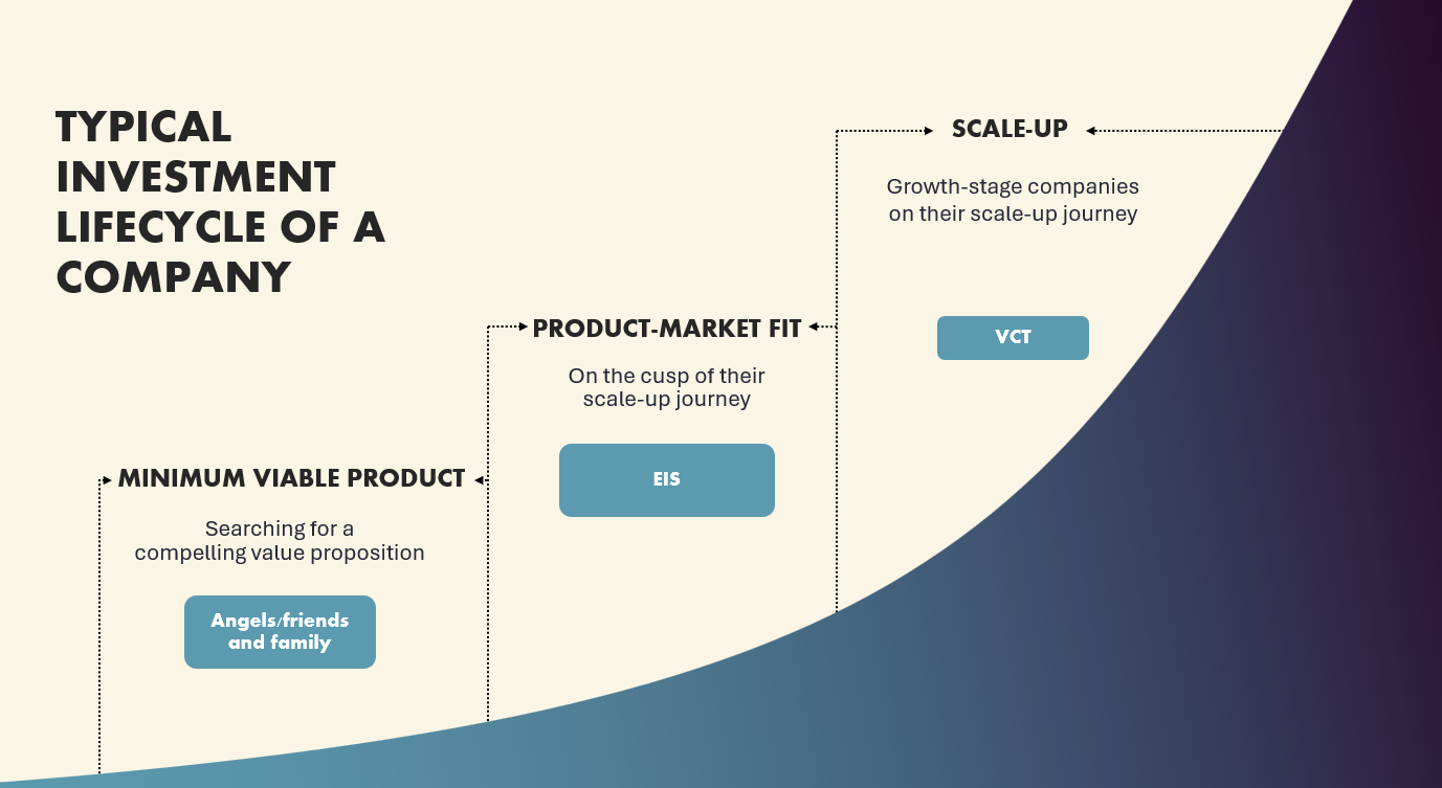
Now that there is going to be a difference in the upfront income tax relief, it is more subjective whether the increased risk of EISs is worth the extra tax relief offered compared to VCTs.
What has not changed is either the limits available to the investor or the other tax breaks offered by the respective investments. For instance, if an investor is wanting to defer a capital gain or remove the assets subject to Inheritance Tax then EIS has and will remain the appropriate solution in comparison to VCT. However, if the investor is after a tax efficient income stream, then tax free dividends offered by VCTs are likely to outweigh the initial difference in income tax relief offered. Indeed, with rise in the dividend tax rate from next tax year, the tax free dividends of VCTs becomes more valuable than it was previously, countering the initial lowering of the income tax reduction over time.